
-
Products
String Energy Storage Inverter ModuleCentralized Energy Storage Inverter CabinetDCDCSTSIntegration SolutionHydrogen Energy Product Portfolio
- Solutions
- About Us
- Cases
- Service And Support
- POLICY
Nov 13, 2026
Share:
01 Why Are Energy Storage PCS Systems Moving to a Two-Stage Topology?
In an energy storage system, the PCS (Power Conversion System) is the core power conversion device connecting the battery to the grid. According to GB/T 34120-2023, PCS topologies are primarily classified into three categories:
Single-stage topology: Consists of a single bidirectional DC/AC converter, which directly converts the battery's DC power into AC power.
Two-stage topology: Consists of a bidirectional DC/DC converter and a bidirectional DC/AC converter. The battery voltage is first regulated through DC/DC conversion before being converted into AC power.
Cascaded topology: Multiple power units are connected in series at the AC terminals.
For a long time, single-stage solutions have dominated the market thanks to their fewer conversion stages, high efficiency, and simple structure. However, as battery technology advances, several limitations have begun to emerge:
The voltage range of next-generation high-capacity battery cells continues to expand. With a wide voltage range of 1000V–1500V, it becomes difficult for single-stage DC/AC systems to maintain high efficiency across the entire operating range.
When the battery voltage drops to the lower end of the voltage range, the output capability of single-stage solutions becomes limited, preventing them from operating at full load.
As AC-side systems evolve toward higher voltage levels such as 800V AC, greater demands are being placed on DC bus voltage regulation and support capabilities.
This is precisely why the two-stage DC/DC + DC/AC topology was developed. The front-end DC/DC stage regulates the battery voltage across a wide operating range, providing a stable DC bus for the subsequent DC/AC stage and ensuring that the inverter operates under optimal conditions.
02 Single-Stage vs. Two-Stage: Understanding the Key Differences at a Glance
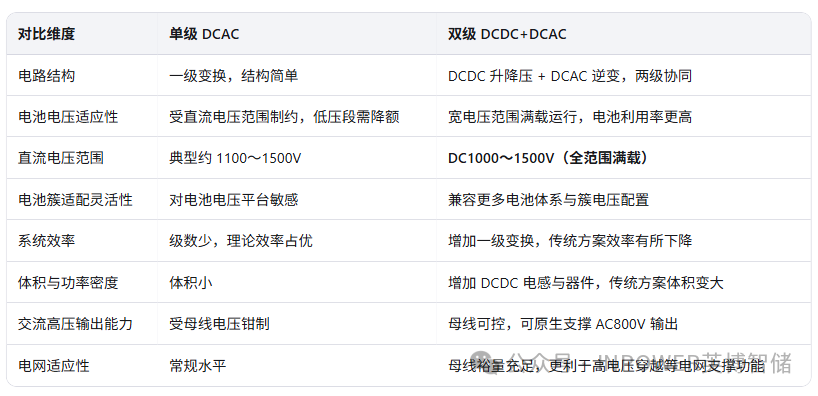
The conclusion is clear: two-stage topologies offer significant advantages in battery adaptability, compatibility with evolving voltage platforms, and grid support capabilities. However, the industry has long had two major concerns: lower efficiency and a larger footprint.
These are precisely the two long-standing challenges that INPOWER ENERGY's new-generation 250kW all-SiC two-stage PCS (INPPCS-250/0.8-W-13-OS-B1) is designed to overcome.
03 Three Key Breakthroughs That Redefine Two-Stage PCS
Breakthrough 1: All-SiC Technology Delivers Single-Stage-Level Efficiency
Because traditional two-stage solutions involve an additional conversion stage, their overall efficiency is typically 0.5–1 percentage points lower than that of single-stage solutions. Over long-term operation, this translates into substantial energy losses and higher operating costs.
INPOWER ENERGY's 250kW two-stage PCS adopts all-silicon carbide (SiC) power devices. With low switching losses, high switching frequencies, and excellent high-temperature performance, SiC technology minimizes losses across both the DC/DC and DC/AC stages. Actual test results show that:
The maximum overall conversion efficiency reaches ≥99%.
Across the full battery voltage range of DC 1000–1500V, the charging and discharging efficiency curves are almost identical to, and in some operating regions even outperform, those of the previous 215kW single-stage model featuring a hybrid SiC and silicon design. At battery voltages above 1330V, the two-stage model achieves even higher discharge efficiency.
Breakthrough 2: Higher Power Density with an Additional DC/DC Stage—Same Dimensions, Direct Replacement
Adding a DC/DC stage typically requires a redesign of the power inductors, components, and cooling system. As a result, the perception that two-stage PCS units are larger and heavier has become widely accepted in the industry.
Through high-frequency all-SiC design and a highly integrated structural layout, INPOWER ENERGY has seamlessly integrated the DC/DC stage into the original enclosure:
Overall dimensions: 750mm (W) × 275mm (H) × 820mm (D), exactly the same as those of the previous 215kW single-stage model.
Overall weight: approximately 100kg. The mounting hole positions, air intake and exhaust design, and AC/DC connection locations remain unchanged.
Power density increases rather than decreases: output power rises from 215kW to 250kW within the same enclosure dimensions, representing an approximately 16% increase in power density.
For customers, this means no modifications to the cabinet, mechanical structure, or airflow design are required. The existing unit can be directly replaced, enabling an upgrade from single-stage to two-stage technology and from 215kW to 250kW.
Breakthrough 3: Native 800V AC Platform with 1.3 p.u. High-Voltage Ride-Through Capability
Designed for 800V AC systems, this model features a rated AC voltage of 800Vac (-15% to +10%), three-phase three-wire output, and a rated output current of 181A. It can connect directly to an 800V AC bus, reducing line losses and busbar costs associated with low-voltage, high-current systems.
Thanks to the stable and controllable DC bus enabled by its two-stage topology, the PCS delivers excellent grid fault support capabilities. During type testing conducted in accordance with GB/T 34120-2023 and GB/T 34133-2023, the model successfully passed all high-voltage ride-through tests:


Measured high-voltage ride-through waveform: Within the A-B cursor interval (approximately 0.5 seconds), the three-phase AC voltages (AC-U1/U2/U3) rise to 1.3 times their rated value, while the three-phase currents (AC-I1/I2/I3) remain under controlled output. The PCS stays connected to the grid throughout the entire event.
In addition, the PCS passed all grid adaptability tests on the first attempt, including low-voltage ride-through, continuous low-voltage ride-through, and continuous low-to-high-voltage ride-through. It meets all the latest national standards for grid-friendly energy storage PCS performance.
04 Overview of Actual Type Test Results
All performance indicators have been verified through comprehensive third-party type testing conducted in accordance with GB/T 34120-2023, Technical Requirements for Power Conversion Systems in Electrochemical Energy Storage Systems, and GB/T 34133-2023, Testing Code for Power Conversion Systems for Energy Storage.

05 Conclusion
The debate between single-stage and two-stage topologies is not fundamentally about the number of conversion stages. It is about achieving the right balance among battery adaptability, efficiency, power density, and grid support capabilities.
INPOWER ENERGY's 250kW all-SiC two-stage PCS demonstrates three key capabilities:
Two-stage does not have to mean lower efficiency. Its all-SiC design delivers efficiency on par with single-stage solutions, with a maximum efficiency of ≥99%.
Two-stage does not have to mean a larger footprint. With the same dimensions, mounting configuration, and wiring layout, it enables direct replacement.
Two-stage can deliver more. With a native 800V AC platform, full-load operation across a wide DC 1000–1500V range, and 1.3 p.u. high-voltage ride-through capability, it is designed for 1500V energy storage systems and grid-friendly power plants.
In the era of wide voltage ranges, two-stage technology is the way forward.
Click the link below to access the product brochure.
INPPCS-250-0.8 Product Brochure.pdf
Note: The efficiency data presented in this article are based on the type test report and measured charging and discharging efficiency curves. The test conditions included rated AC voltage and a battery voltage range of DC 1000–1500V. Product specifications are subject to the latest version of the user manual (V01.01.02).
Related News


